Should Everyone Do Everything Now?
Something shifted in the last year that I don't think we've fully internalized yet: the cost of being dangerous in a discipline adjacent to yours just dropped to near zero.
For most of the past decade I've been building products, the boundaries between engineering, product, and design were pretty firm. You'd wait on a designer for mocks. You'd wait on an engineer for hitting the first milestone. You'd Slack your PM for a decision to "unblock yourself" and hope they still have the whole context. That model has broken down, and as we all know, this is what's possible:
-
If you're an engineer, you can now prototype a decent UI without waiting on a designer. You can talk to customers, synthesize what you hear, and write a credible product brief — because AI tools help you structure your thinking and fill gaps in your knowledge. You don't need to become a designer or a PM. But you can be dangerous in both.
-
If you're a designer, you can now build real, working prototypes in code — not just clickable mockups, but actual implementations that could ship to main. The gap between "design intent" and "what gets built" is collapsing because you can close it yourself.
-
If you're a PM, you can now understand what engineering tradeoffs actually look like by spinning up code, reading pull requests with Claude Code, and firing up Cursor agents to fix the bugs, rather than just writing specs and hoping for the best.
This is genuinely exciting, right? Yes, absolutely.
But, there's also a danger lurking here that I feel people are underestimating.
Staying in your lane was easy. You didn't design because you couldn't, and that was that. Now that an engineer with Claude Code can produce something that looks like a real design in twenty minutes, they'll be tempted to ship it. And it'll be fine. Not good, just fine — messing up the information hierarchy, deviating from the design system, violating a handful of other basic design layout principles: the dozens of micro-decisions a designer makes without thinking about it.
Worse, Dunning-Kruger kicks in fast here. AI gets you to the peak of "Mount Stupid" in record time. You produced something that looks polished, so you assume you've done the job. No, you haven't. You've done the easy 70%.
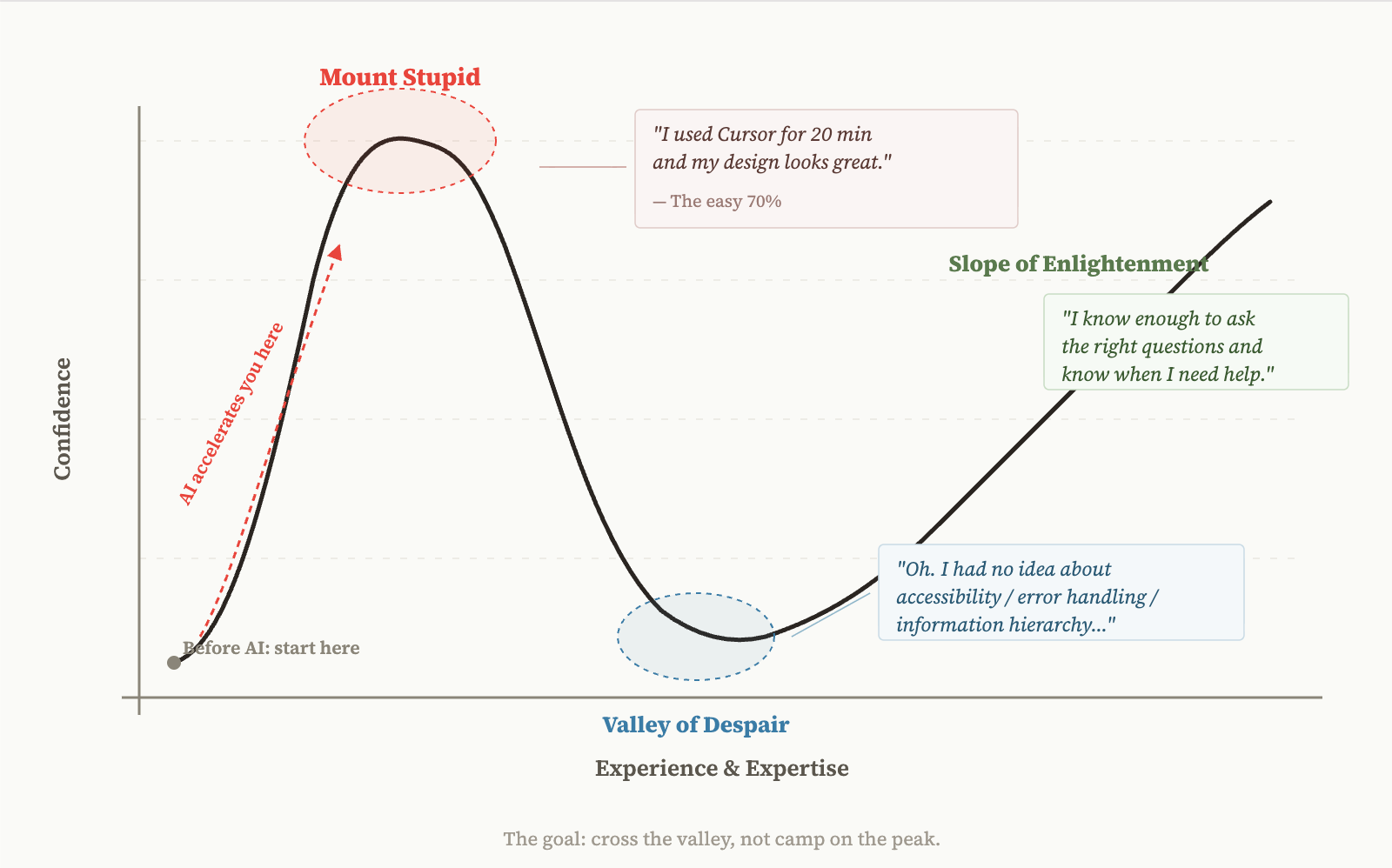
The same applies in every direction. A designer shipping code doesn't know what they don't know about error handling and edge cases. They don't know about patterns that got deprecated across the company in 2023, but still are scattered all across our messy codebases. A PM who can read code with Claude Code might overestimate their ability to evaluate architectural decisions, care about latencies, and make the app 'feel slick' — something veteran engineers are connoisseurs of.
So the actual call to action isn't just "learn the other disciplines." That's sloppy advice! It's to learn the other disciplines with enough depth to know where your judgment runs out. Understand what designers actually do, not just what their deliverables look like. Understand why engineers push back on certain approaches, not just how to get a Cursor agent to open a PR for you.
Use AI to cross boundaries faster and pair it with genuine curiosity about the craft on the other side, instead of dismissing the need for entire professions.
The floor has been lowered. But the gap between "I can produce this" and "We should ship this" is where the real work starts. Moderation is always harder than abstinence, and since abstinence is no longer an option, we have to learn the limits of our ever expanding skill boundaries, build good judgement, and put out our output accordingly.
In short, don't become a Slop Cannon as you expand the kinds of work you professionally do.